
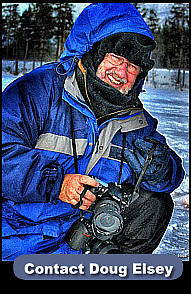
About Doug Elsey
A Life Behind the Camera
Doug Elsey is a professional engineer and documentary photographer specializing in high-risk, remote, and operational environments. His photography is not observational. It is informed by decades of direct responsibility for the work being documented. That background matters — because in environments where failure has consequences, access is earned through competence, not credentials.
“I never set out to become a professional photographer.
My career was in engineering, commercial diving, and project management. Photography developed alongside it until, over time, it became a second profession. The camera accompanied me through a lifetime of exploration, engineering, and adventure, eventually becoming as important a tool as my dive helmet or my engineering drawings.
Sometimes I was part of the project and simply happened to have a camera with me. Other times I was asked to document the project because of my ability to understand what was happening from the inside. Those two careers grew together and, over more than fifty years, produced a visual record of places, people, and projects that few photographers have had the opportunity to experience.
My work has taken me beneath Arctic sea ice, living in underwater habitats, aboard naval vessels, onto scientific expeditions, through commercial diving operations, across wilderness coastlines, and beneath the tropical waters of the Caribbean. Along the way I have photographed explorers, engineers, military specialists, scientists, commercial divers, wildlife, and landscapes—always with the belief that the best photographs come from understanding the story before pressing the shutter.
I have been privileged to participate in pioneering underwater projects, including Arctic III and Arctic IV under the leadership of Dr. Joseph MacInnis. As project engineer for Canada’s first underwater habitat, SUBLIMNOS, I produced the engineering drawings for SUBIGLOO—the world’s first polar undersea station—and helped install it beneath the Arctic ice at the North Magnetic Pole. Later, as project manager for the Arctic IV expedition, I accumulated hundreds of hours beneath the ice and completed what was then the world’s first deep helium dive beneath the Arctic Ocean.
Throughout my career I worked in senior management positions within the commercial diving industry as an engineer, project manager, commercial diver, diving supervisor, submersible pilot, ROV operator, and diving instructor. Those experiences provided opportunities to document underwater engineering, marine construction, offshore operations, and the people whose work is rarely seen by the public.
For more than two decades I also documented multinational NATO Naval Mine Countermeasure and Explosive Ordnance Disposal Special Forces exercises throughout Europe and North America, working alongside elite military diving units from Canada, Norway, the United States, Belgium, Germany, the Netherlands, Finland, Sweden, Portugal, Iceland, and Italy. These assignments demanded not only technical photographic skills but also an understanding of complex operations, trust, and the ability to work comfortably in demanding environments. It was never easy.
Photography has also allowed me to share my passion with others. For ten seasons I taught field photography during sea kayaking expeditions with White Squall in Ontario’s Georgian Bay, helping participants learn not only how to make better photographs but also how to see the landscape with greater patience and curiosity. Today I continue to photograph the underwater world in Roatán, Honduras, creating images that promote diving and inspire others to discover life beneath the surface.
Although photography has generated commercial assignments for clients around the world, it has always meant something more to me than earning a living.
It has been my way of preserving history.
Looking back over hundreds of thousands of photographs, I realize they are not simply pictures of expeditions, engineering projects, wildlife, or military operations. They are photographs of people—people exploring, building, discovering, serving, teaching, and quietly doing extraordinary work.
This website is not intended to be a commercial portfolio.
It is my personal archive.
It is a collection of photographs gathered during a lifetime of participation, observation, curiosity, and privilege. Together they tell the story of the remarkable people, places, and projects that I was fortunate enough to experience.
If these photographs encourage someone to look a little closer, appreciate the work of others, or preserve a piece of history that might otherwise have been forgotten, then they have fulfilled their purpose.”
Selected Photo Clients & Publications
National Geographic Society • National Geographic Adventure Magazine • Explore Magazine • Air Canada enRoute • TVOntario • Canadian Department of National Defence • Toronto Sun • Popular Mechanics • Science Magazine • The Globe and Mail • NATO Naval Special Forces • Norwegian Naval Special Warfare Group • Icelandic Coast Guard EOD Command • White Squall • Oceaneering International • Diver Magazine • Adventure Kayak Magazine • U.S. Navy Faceplate Magazine • and numerous books, magazines, newspapers, and online publications.
What Others Have Said
“Doug Elsey is a masterful documentary photographer. An essential member of my Arctic expeditions, he has an uncanny ability to ‘see’ the shot and capture its essence. His experience as an ocean engineer and explorer of the natural world adds unique dimensions to his work. Doug’s the kind of photographer you want when it’s 4 a.m. and the temperature is forty below. He’s smart, tough, and determined to get the impossible shot. And he does it with a wicked sense of humour.”
— Dr. Joseph MacInnis
Physician, Scientist, Undersea Explorer and Author
“In his style of work, Doug combines the precision of a trained engineer with the eye and sensibility of an artist. He consistently delivers material that is not only thoroughly detailed, but also aesthetically compelling. We have relied on Doug to document major underwater projects in Canada, the United States, and overseas, and continue to value both his professionalism and his results.”
— Dr. Phil Nuytten
Founder, Nuytco Research Ltd. / Can-Dive Construction
“Doug Elsey has photographed the Deep Divers of the Norwegian Navy during several international exercises. His ability to capture the drama of our operations in some of the world’s harshest marine environments has enabled us to demonstrate both our people and our equipment at their very best. His documentary photography tells our story through powerful images that capture both the emotion and the reality of the moment.”
— Norwegian Naval Special Warfare Group (EOD Commando)
“Thank you for allowing us to use your work in Faceplate. Your photographs tell the story even better than the words themselves. Amazing work.”
— Faceplate Magazine
Official Publication of the U.S. Navy Divers and Salvors
“Doug Elsey has a gift—an instinctive ability to capture the true ambience, serenity, and drama of the underwater world. He integrates seamlessly with any team, earning trust while creating photographs that genuinely reflect both the people and the environment. We are extremely grateful for his contribution.”
— Canadian Experimental & Undersea Research Group / UK Royal Navy Clearance Divers Group